
Designed a 0→1 AI-powered Personal CFO that helps Gen Z turn financial insights into action.
*The concept received full executive approval and is now moving into development.
Role
Product Designer
Team
1 Product Manager
2 Designers
5 Engineers
Timeline
Aug 2025 – May 2026
Research & Strategy: Aug – Nov 2025
Product Definition & Executive Approval: Dec 2025 – April 2026
Design & Development Prep: May 2026 – Present
Tools
Figma, Miro, Google Docs, Slack
About the service
An AI-powered personal CFO that helps people understand what to do next with their money.
Why this project existed
People don’t struggle to access financial information.
They struggle to act on it.
Despite having access to more financial data than ever before, many people still struggle to prioritize goals, build habits, and make confident financial decisions. The result is a growing gap between financial insight and meaningful action.
Benjamin started with a simple question:
What if AI could function less like a dashboard and more like a personal CFO?

How research shaped the product
25 surveys · 8 interviews
Finding 1
Need direction; no more data
Many participants felt overwhelmed by financial information, yet uncertain about what to do next.
Design Principle
Guide, don't overwhelm.
We designed an advisor instead of a dashboard.
Finding 2
Low financial knowledge
62.5% of participants rated their financial knowledge as below average. Many wanted guidance they could understand and act on.
Design Principle
Educate in context.
We prioritized coaching over manual budgeting.
Finding 3
Trust is open, but conditional
People were surprisingly receptive to AI-generated financial advice, but wanted transparency and control.
Design Principle
Build trust before automation.
We made trust visible by explaining reasons and keeping users in control before automation.
MVP scope
Personalized Recommendations
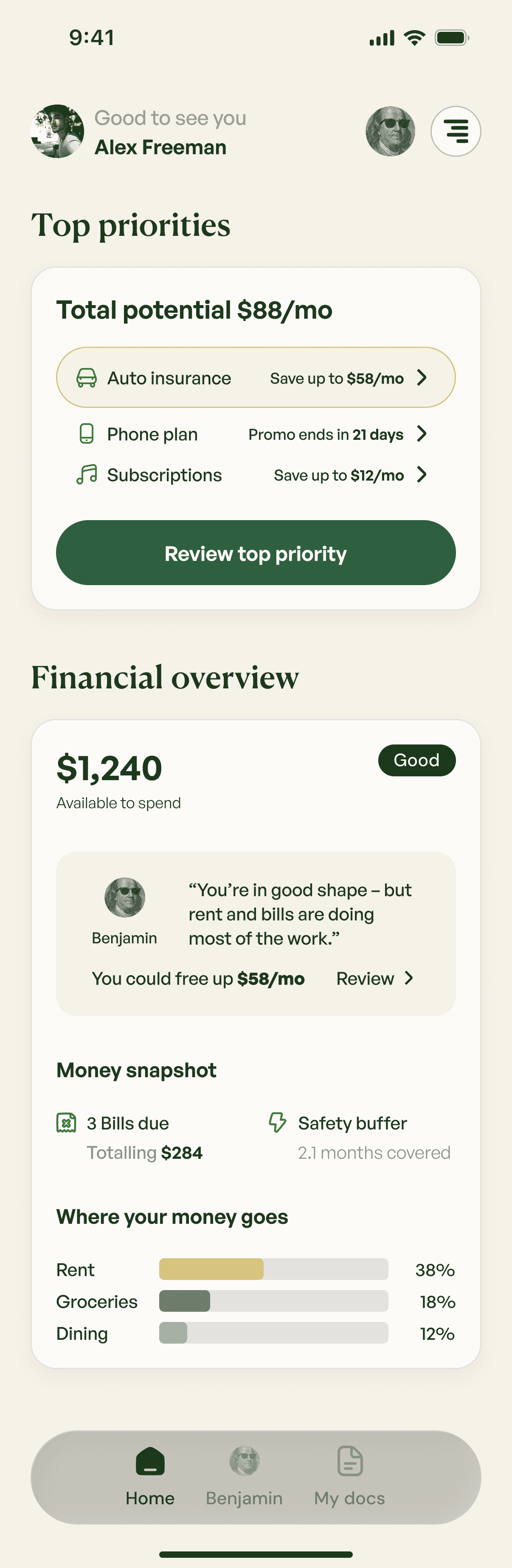
The core question was what to show first. Two options were on the table: a spending overview (familiar, expected) or a prioritized action list (unfamiliar, but directly addresses the research gap).
I chose the latter. A spending overview answers "how am I doing?" — a question users already know the answer to. A priority list answers "what should I do right now?" — the question nobody else was answering. The survey backed this up: 80% of respondents said what they most needed was automated recommendations, not more data to browse. Users didn't want a better mirror. They wanted a guide.
AI Chat

Most AI chat interfaces wait for the user to ask. Benjamin leads. The default state isn't an empty prompt — it's a proactive insight with a concrete next step already surfaced.
This was a deliberate inversion of the pattern I saw in the early budget tracker, where the suggested prompts still required the user to initiate every decision.
Bill Detail

The temptation was to show everything — full bill history, all line items, complete breakdown. Instead, Benjamin surfaces one recommendation tied directly to the bill data, explains why it matters, and shows the budget impact in plain numbers.
The tradeoff: less information density, more decision clarity.
Document Upload

The question here was how much to ask from the user upfront. More data means better recommendations — but a long setup flow was exactly the kind of friction that caused drop-off in the early tracker.
The decision: ask for documents once, at a moment of clear value. Instead of a mandatory onboarding step, document upload is triggered contextually — when Benjamin spots a gap in your data and needs more to make a recommendation.
The tradeoff: slightly less personalization on day one, but a setup experience that doesn't feel like homework.
Future considerations
As Benjamin evolves, financial guidance could be enhanced through expert-curated knowledge, licensed financial content, or partnerships with domain specialists.