Led the mobile UX/UI from end to end, creating a scalable design system and core flows. Added interactive maps, messaging, clearer room details, and a more secure, streamlined booking process to improve usability and trust for international users.
Impact
1M MAU
20× traffic growth post-launch
iOS conversion: 4.3% → 20.3%
₩1B+ revenue in first weeks (525 bookings)
11.6K installs shortly after launch
Role
Product Designer
Team
2 Product Managers
2 Engineers
2 Designers
Timeline
Nov 2024 - Feb 2025
(12 weeks)
Tools
Figma, Notion, Google Docs, Google Sheets, Slack, and etc.
About the service
EnkoStay connects international travelers with safe, reliable long-term stays in Korea.
The Problem
International users faced several friction points on EnkoStay’s web platform:
Difficult to search, evaluate, or book accommodations on mobile
Poor mobile usability created high drop-offs during key tasks
Low clarity and trust when viewing room details or contacting hosts
We needed to redesign the experience as a mobile app that improved accessibility, clarity, and trust for global travelers.
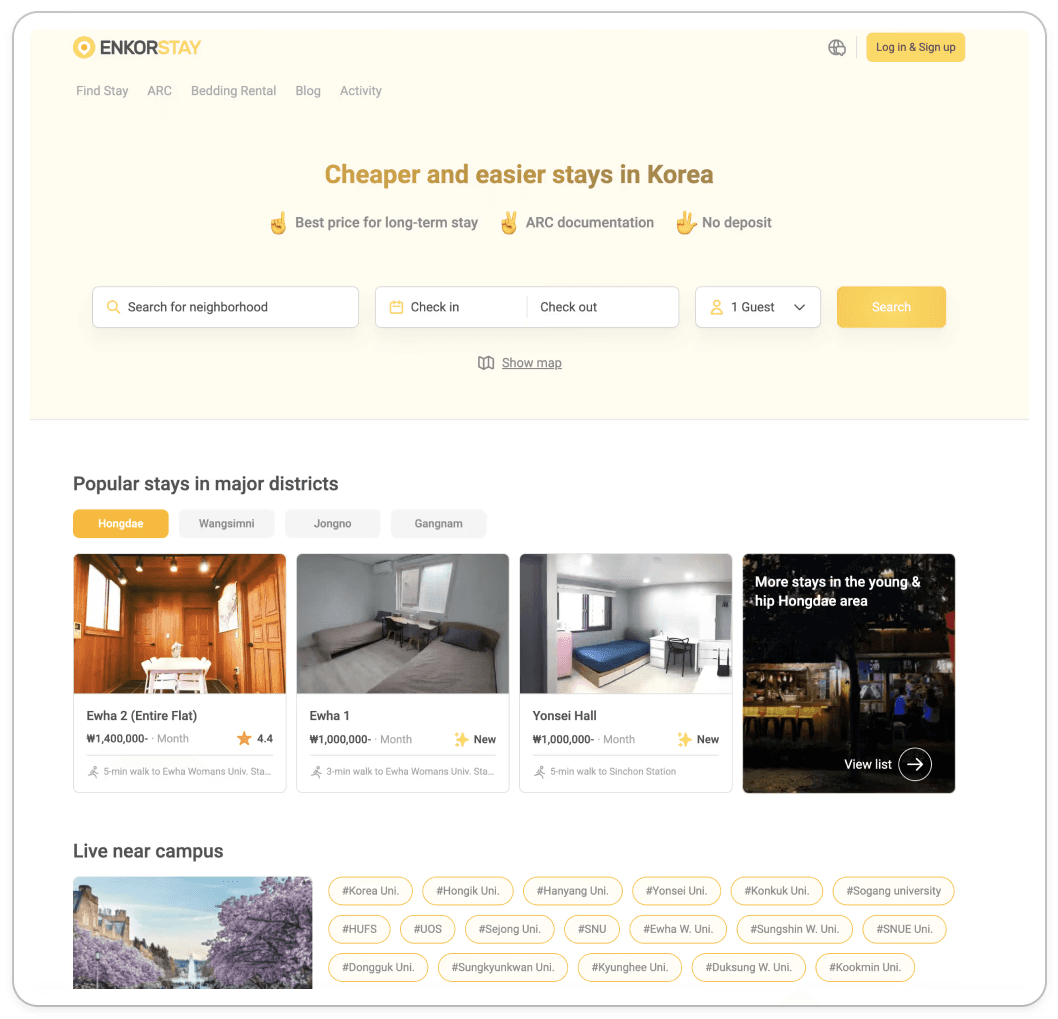
<Before>
Desktop-first, unoptimized for mobile or global users
Pain Points
Navigating "Blind" Locations
Fearing False Listings
Overcoming Deposit Shocks
Battling Complex Paperwork
Struggling with "Bare" Essentials
We conducted 200+ survey responses to gain a deeper understanding of potential users, their pain points, and needs.
What International Renters Care About
Through the survey responses and analysis, we identified the 5 key factors international renters prioritize when searching for housing.
Affordability & Convenience
Affordable pricing
Listings near schools, offices, and popular destinations
Trust & Transparency
Trustworthy listings
Transparent pricing and processes
Local Context
City and neighborhood resources
Points of interest (schools, workplaces, landmarks)
Global Accessibility
Language support (i18n)
Local currency payment options
Community
Community activities and social connections
Product Principles
These principles guided the web-to-mobile transition, building trust for international renters.
Context Over Content
Prioritizing spatial context (Map) over list views to aid location-based decisions.
Trust via Transparency
Replacing subjective ambiguity with objective data (Metrics, Policies) to build confidence.
Localize the Logic
Adapting complex local systems (Payments, Rent) to fit the international user's mental model.
Architect for Action
Designing proactive UI flows (Upsells, Filters) that guide users toward conversion.
Solutions
Context-First Discovery
Hyper-localization for Residents, not Tourists.
University-Centric Map
Replaced static text lists with interactive chips
Inventory Visibility
Exposing Constraints Upfront to Minimize Dead Ends.
Visualized Availability
Standardized unstructured data
Trust-Driven Transaction
Removing Psychological Barriers to Unblock Revenue.
Quantifiable Trust
Clear Cancellation Policy
Goals
User Goal
To find a safe, "living-ready" accommodation without facing dead ends or uncertainty.
Business Goal
Maximize Demand Capture by removing friction in the search-to-booking funnel.
Task 1
Contextual Disconnet
Design Focus: Contextual Clarity
Final Ver.
Station/Univ. based Map View
"Map-First Interface."
Unlike tourism apps, I prioritized 'Living Infrastructure' (Distance to University, Subway lines) over tourist landmarks to aid daily commute decisions.
< University-Centric View >
< Station-Centric View >
Iterations
Problem: Standard list-views fail when users lack local geographical knowledge.
Impact
Accelerated Time-to-Decision — Shortened the search-to-click time by visualizing key anchors (Campus, Subway) instantly, removing the friction of decoding local addresses.
Eliminated "Location Anxiety" — Provided immediate location certainty, reducing the anxiety of booking a home in an unfamiliar city.
Future Considerations
Time-based search — search places within 20 min from a univ.
Vibe map — near a good food scene, quiet neighborhood, local hotspot
Capturing intent first — asking the 'Why' (Student/Worker) to tailor the map experience at the onboarding process
Task 2
Killing "Blind Search"
Design Focus: Transparency & Efficiency
Final Ver.
Data Standardization
Converted unstructured text (ARC support, Bedding, Women-only) into filterable tags to reduce decision fatigue.
< Room Detail View >
Final Ver.
Calendar Logic
Visualized 'Minimum Stay' rules upfront to prevent 'No Result' dead ends.
< Calendar view >
< Calendar View for Other Units >
Iterations
Problem: Users faced high drop-off rates due to unstructured data and hidden 'Minimum Stay' rules.
< Before >
Assumption: "Users are most afraid of scams, so showing the Host profile first establishes trust immediately."
Friction: Forced scrolling for deal-breakers (ARC, Gender). If the room doesn't fit, the host is irrelevant.
< After >
Strategy: Reordering for Efficiency.
Moved 'Room Essentials' (ARC, Women-only, Deposit) to the top. Users filter by utility first.
Moved 'Host Profile' to the bottom but Enhanced Credibility.
Trust Mechanics
Added "Verified Badge" & "Response Data" (Time, Acceptance Rate).
Rationale: Trust belongs in the Commitment Phase (bottom), not Discovery (top).
< Before: Linear Text Description >

The Issue: Location details were presented as a static, unstructured text list. Users had to read every line to find relevant landmarks (e.g., subways), causing high cognitive load.
< After: Interactive Context Filters >
The Solution: I structured the location data into clickable chips (Subway, Bus, University). This allows users to filter the map view instantly based on their priority—whether it’s commuting or going to class—transforming a "reading task" into a "visual scanning task."
Impact
Reduced Friction: Eliminated the "Guessing Game" in date selection, aiming to lower search abandonment.
Higher Match Efficiency: Ensured every click leads to a bookable room by exposing hidden constraints upfront.
Optimized Discovery: Empowered users to find "Living Infrastructure" instantly via context-aware map filters.
Future Considerations
Flexible Date Search: Implement a "+/- 3 days" option to maximize match rates for flexible schedules.
Availability Waitlist: Turn dead ends into future bookings by allowing users to waitlist popular listings.
Semester Presets: Align search logic with student lifecycles via one-tap academic term filters.
Task 3
Establishing Trust & Unblocking Revenue
Design Focus: Psychological Safety
Final Ver.
Trust-driven Transaction
Converting High-Intent Users by Removing Psychological & Technical Barriers.
< Check out Flow >
< Mitigating Sticker Shock via Split Payments >
Iterations
Problem: High friction in payment due to fear of scams and inflexibility in long-term commitments.
< Before >
Ambiguous Counter
Lack of Context: A simple quantity input failed to clarify if bedding was included, leading to user confusion and missed purchases.
Generic Brand Selection
The Error Trap: Merely listed card brands (Visa, Amex) without distinguishing the issuer.
Technical Friction: In Korea, using a domestic Visa card on a global payment gateway often leads to transaction failures. The UI failed to prevent this mismatch.
Ambiguous Text Block
High Cognitive Load: Relied on dense, static text at the bottom of the summary to explain complex refund rules.
< After >
Active Choice Architecture
Forced Binary Choice: Replaced the passive counter with Yes/No radio buttons, compelling users to make a deliberate decision to boost attachment rates.
Contextual Nudge: Added a clear disclaimer ("Not included by default") to justify the upsell and eliminate uncertainty.
Visual Reinforcement: Used active states (yellow background) to confirm the selection and encourage the add-on.
Issuer-Centric Selection
Logic for Success: Categorized options by "Foreign-Issued vs. Korean-Issued" instead of card brands.
Error Prevention: This forces users to self-select the correct payment path upfront, routing them to the appropriate Payment Gateway (PG) and significantly reducing technical transaction failures caused by incompatible authentication methods.
After: Dynamic Policy Timeline
Scenario-Based Logic: Clearly separated the "Before Host Approval" (Risk-Free) stage from the "After Host Approval" stage. This assures users that their money is safe while waiting for the host's decision.
Visual Timeline UI: Introduced a vertical timeline with status indicators (Green dots) to visualize the 24-hour free cancellation window and exact penalty deadlines (e.g., "Feb 03 3:00 PM").
Reduced Purchase Anxiety: By making the "Exit Strategy" (Refund) explicit and visual, I lowered the psychological barrier to committing to a high-value transaction.
Impact
Revenue Growth via Conversion & Upsell
Frictionless Transaction
Operational Efficiency
Future Considerations
Pre-booking Chat — allowing communication before payment to validate hosts.
Clearer long-term rental pricing & auto-pay options
Data-driven optimization across the booking funnel